

🔷 I’m creating a course to help you safely and confidentially design a freedom-focused business plan before you quit your job. Interested in joining a future Exit Blueprint cohort with a small group of like-minded peers? Sign up to be notified!
As a coach, I frequently talk with people who want to quit their jobs. They’re frustrated, angry, and stressed about their projects at work and relationships with coworkers and management.
They feel anxious about their job performance and fear they might receive a bad review or be placed on a layoff list. The thought of continuing to work for their employer every day for several more years is depressing.
I hear statements like:
“They don’t appreciate me.”
“I don’t feel respected at work.”
“My boss isn’t investing in me.”
“I never receive any training.”
“I don’t feel like I’m growing in my job.”
“I want to walk away now, even though I don’t have another job lined up.”
“I’ve lost faith in my abilities.”
“I’m beginning to doubt myself.”
“I’ve lost my mojo.”
These feelings are more common than you might think. Our work has a significant impact on our sense of wellbeing.
I’ve shared this data before from research by Clarine M. Jacobs, Ph.D., published in Ineffective-Leader-Induced Occupational Stress:
~75% of employees said their leader is their most significant source of stress.
~70% of employees said their work is a substantial source of stress.
~80% of employees experienced stress-related physical symptoms (e.g., fatigue, irritability, anger, lack of motivation, headaches).
It can take several months or even years to recover from a toxic work environment or a terrible boss who tears you down and destroys your confidence. I’ve experienced that myself. I didn’t feel like my normal self for almost six months after I quit a job that had an incredibly negative, backstabbing culture.
I thought I could push through the stress and anxiety that I was feeling in that job. But I paid a steep price for not dealing with it (e.g., my health suffered considerably). However, I eventually took steps to get it under control, and I changed my life for the better forever.
Years ago, I shared some strategies and techniques to relieve stress. I’ve found that actively managing my stress levels also dramatically improves my creativity and productivity. Maybe some of these can help you too!
However, these strategies still feel more like a painkiller than an actual solution. They treat the symptoms more than they stop the stress and anxiety from happening in the first place.
I’ve thought more about this problem, worked with clients struggling with stress and anxiety, and managed my own issues and struggles with depression. I still use all the techniques I shared to manage my symptoms. But I’ve found that it’s better to head them off at the pass sooner.
One of the most effective and lasting strategies is to take complete control of what you believe is your life’s mission versus simply adopting your employer’s mission and giving your heart and soul to a company that doesn’t really care about you. Owning your sense of purpose gives you more control over your physical, mental, and emotional health.
I made that mistake earlier in my career. I drank my employer’s “Kool-Aid” and threw myself into that job 100%. My sense of identity was tied to my job title and the company’s mission.
That was a huge mistake.
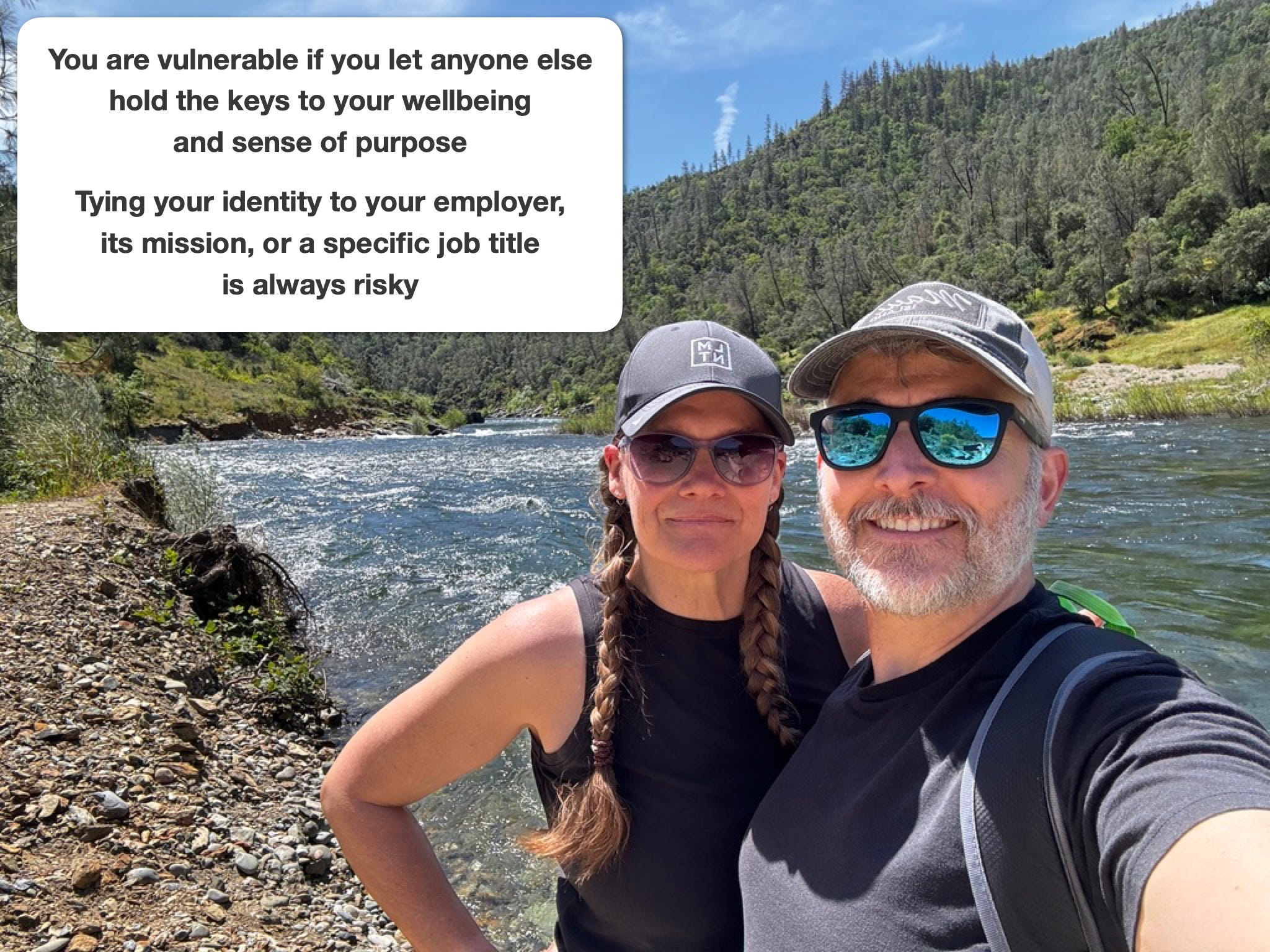
You are vulnerable if you let someone else (e.g., an employer) hold the keys to your wellbeing and sense of purpose. Tying your identity to your employer, its mission, and a specific job title is always risky.
When a project fails, you feel like a failure.
When your boss gets upset with you, you feel stressed and anxious.
When your world-changing product gets canceled, you get depressed.
What happens if your employer makes a strategic pivot away from the mission you committed to for years?
What happens if your company gets acquired and the new leadership changes everything (e.g., your title, role, projects, etc.)?
What happens if you get demoted or lose your job?
Don’t fall into that trap as I did.
Yes, you should absolutely have a job or run a business that feels meaningful. But your sense of purpose needs to rise above that. It should endure beyond the boundaries of any specific job or company.
When you have a sense of purpose, and your efforts have meaning, you can keep going and push through almost anything. But they need to be under your control.
I work one-on-one with my coaching clients and give them “homework exercises” to explore and create their personal vision and mission. We discuss how this can become their purpose in life instead of solely focusing on what an employer wants them to do for their job.
I know that when I created my purpose; I felt more in control, and that reduced my anxiety. I look forward to every day because I will work on my mission. Having a meaningful sense of purpose takes the edge off my seasonal depression too, which became a little less seasonal and a little more persistent in past years.
For most of my life, I didn’t feel like I had a purpose. Over a decade ago, I probably had some shallow, corporate, materialistic answer to the question, “What is your purpose in life?”
But now? Now, I finally feel like what I’m doing matters.
When I launched Invincible Career and started working with people who were frustrated with their jobs, feeling sad about their careers, and wondering about their future, it made me realize I was finally doing something that actually helps people! I could see the change in their confidence, happiness, and hope for the future. I’d never experienced that before in my corporate jobs.
So, this is how I answer that question today:
“My purpose in life is to empower good people and give them the confidence to plan, create, and live the life they deserve.”
I want to give you a sneak peek at some of the homework I give my clients. We work on this very exercise of exploring and defining their purpose, vision, and mission to align their career path with what matters most to them.
A calling versus a passion
Not long ago, it became quite popular to tell people to follow their passions. I’m not a fan of this recommendation because I think it misleads people. They believe they can identify a passion and then make a living from it. Easy, right?
My problem with this is:
Something might be a passion (e.g., playing guitar), but that doesn’t mean that you are actually good at that thing.
You may have a passion for something (e.g., birdwatching), but it doesn’t solve a problem or meet a need for anyone else. Therefore, no one will pay you to pursue this passion.
Finally, when someone turns a passion into a way to make a living (either as an employee or an entrepreneur), they often lose their passion for that very thing. For example, there are many stories of people who loved singing for fun but lost their passion for it once it became a job to pay the bills.
I would rather have my clients think about their “calling.” A calling isn’t necessarily a passion, although you can feel passionate about pursuing a calling (many people do). It also isn’t necessarily fun to pursue a calling, but you feel drawn to it and driven to make it happen. Some might call that an obsession. I prefer to think of it as finding meaning and fulfillment in life.
I see a calling as something that taps into your core talents, strengths, knowledge, and experience in a way that changes the world or improves the lives of others in a meaningful way. It is valuable enough to these people that you can, indeed, turn it into a way to make a living for yourself. Your unique way of bringing this to the world gives you purpose every day.
What do you feel compelled to do?
What would you say is your calling?
Your vision and mission
I’ve used a vision and mission framework to propose new corporate projects and formalize business ideas. But I also find it useful for my clients to help capture their thoughts around their calling and purpose.
It helps to think about yourself and the world we live in, since a purpose has more meaning when it improves the world and helps others. The following questions can help.
What does the world need? What problems need to be solved? What are the big opportunities?
What are you great at doing? Think about your natural talents and the skills you’ve acquired. What are your unfair advantages (e.g., you’re brilliant, naturally persuasive, people seem to like you, etc.)?
What do you love doing? Most importantly, what do you love doing that you’re also great at doing?
What can you get paid to do? Unless you’re financially independent, you’ll want to align your purpose with some way to make a living.
Here is an example of how someone might turn the answers to these questions into more meaningful work:
“Sarah has a passion for teaching people how to use new technology. She is great at it and loves doing it. She feels that her calling is to help educate disadvantaged children, thus combining what she loves and what the world needs. Obviously, the world needs educators, and you can get paid to be an educator. So, she created a business to get paid to educate children through online workshops. Now, she focuses on scaling her technology platform and workshop programs to reach more children. She does this to have a larger and more positive impact on them and the world, but also to generate more revenue.”
In this example, Sarah said that her calling is to help educate disadvantaged children. She could expand on this to create a more detailed vision and mission statement for her business.
What is a vision statement? It’s an aspirational view of the future that would inspire yourself and others. As you think about your vision, what would your life ideally look like at the end of the next 15-20 years? How would you like to change the world? What impact do you want to have on others?
What is a mission statement? Your mission is a realistic endeavor you believe will enable your vision to come true. Your personal mission statement will be what you want to commit to for your vision to become a reality.
For example, Sarah might create the following statements for her business:
Vision: Every child is prepared for the future of work.
Mission: We provide disadvantaged children with affordable and accessible educational opportunities to learn the latest technologies to prepare them for their future careers.
Exploring your purpose
You are absolutely unique. No other person on this planet has experienced the same life as you.
No one else has the exact combination of who you are, what you know, and what you are capable of accomplishing. Someone’s exact purpose is just as unique as they are.
For some people, their purpose is deeply tied to a creative act. They can’t imagine life without making “the thing” that gives them purpose every day. This could be writing stories, creating designs, making music, creating art, writing code, etc.
These creators feel compelled to bring their work to life. Even if they weren’t getting paid to create it, they would do this.
For others, their purpose is deeply tied to people. They can’t imagine life without helping certain types of people every day.
Some teachers obviously feel this way about children. Some medical professionals feel this way about patients. So, this type of purpose is less tied to a specific act of creation and more about helping the people they care about the most.
Sometimes, these two types of purpose overlap when a creator uses what they create to help a specific kind of person (e.g., a children’s author who wants to entertain and educate young people).
Now, consider yourself. Do you feel compelled to create something, and you can’t stop doing it no matter what?
Or, do you feel drawn to helping specific types of people, and you believe that your purpose in this world is to make their lives better? You may even be one of the few whose sense of purpose lies at the intersection of both.
What are your thoughts on your purpose?
Once you have your own vision and mission statements, you’ll probably find it easier to define your purpose in life. Your purpose will be to follow your mission to make your vision of the world come true.
Your purpose is larger and more significant than any single project. It’s more meaningful than the work most employers ask us to do. It belongs to you and gives your life meaning beyond jobs that come and go.
Defining and following a purpose—your life’s mission—gives you more control over managing your physical, mental, and emotional health, too. Focusing your energy on making your vision come true takes the edge off any stress or anxiety you might feel in a job, which suddenly seems a little less important in the grand scheme of life.
Of course, when you pursue an Invincible Career, the ultimate goal is to rebuild your career around your own vision, mission, and purpose. Getting there might take years. But when it happens, you can then dedicate all of your time to something that you find personally fulfilling and meaningful.
What is your purpose?
I’d love to hear your thoughts on your purpose. What do you feel is your mission in life? What vision do you want to make come true? How do you want to change the world?
Feel free to share with me in the comments if you’d like. Or, reach out to me. I’m always here to listen.

Larry Cornett, Ph.D., is a career coach who spent 20+ years in Silicon Valley at Apple, IBM, Yahoo, eBay, and several startups as a designer, leader, and product and design executive. Whether you’re fighting for a promotion, navigating a layoff, or planning your exit to independence, he combines executive experience with psychological insight to help ambitious professionals reclaim their power and build an Invincible Career.
➡️ Ready to create an exciting future? Book a free call today to learn how!

Would you like to help support my newsletter and podcast, but don’t want to commit to a monthly fee? Check out my ☕️ Buy Me a Coffee. I’m self-employed, so coaching and writing are how I provide for my family. Thanks for your help!