


Are you familiar with Alex Karp, the CEO of Palantir? He thinks you’d better get used to the reality of the impact of AI on your job.
“This technology disrupts humanities-trained—largely Democratic—voters, and makes their economic power less. And increases the economic power of vocationally trained, working-class, often male, working-class voters. And so these disruptions are gonna disrupt every aspect of our society. And to make this work, we have to come to an agreement of what it is we’re going to do with the technology; how are we gonna explain to people who are likely gonna have less good, and less interesting jobs.”
- Alex Karp (source)
And if you keep up with tech news, you may have seen that Meta is planning large layoffs that could affect 20% or more of the company. They are trying to offset their massive investments in AI infrastructure, but also anticipating the greater efficiencies of AI-assisted employees. Apparently, Zuckerberg believes the company will no longer need a significant number of its current staff.
“We’re starting to see projects that used to require big teams now be accomplished by a single very talented person.”
- Mark Zuckerberg (source)
Even if you don’t work in the tech industry, I’m sure you have witnessed how AI is weaving its way into many of the tools and services we use every day. Some employees encounter more often than others, of course (e.g., knowledge workers). And some folks are fairly insulated from its impact, for now at least (e.g., those with blue-collar jobs).
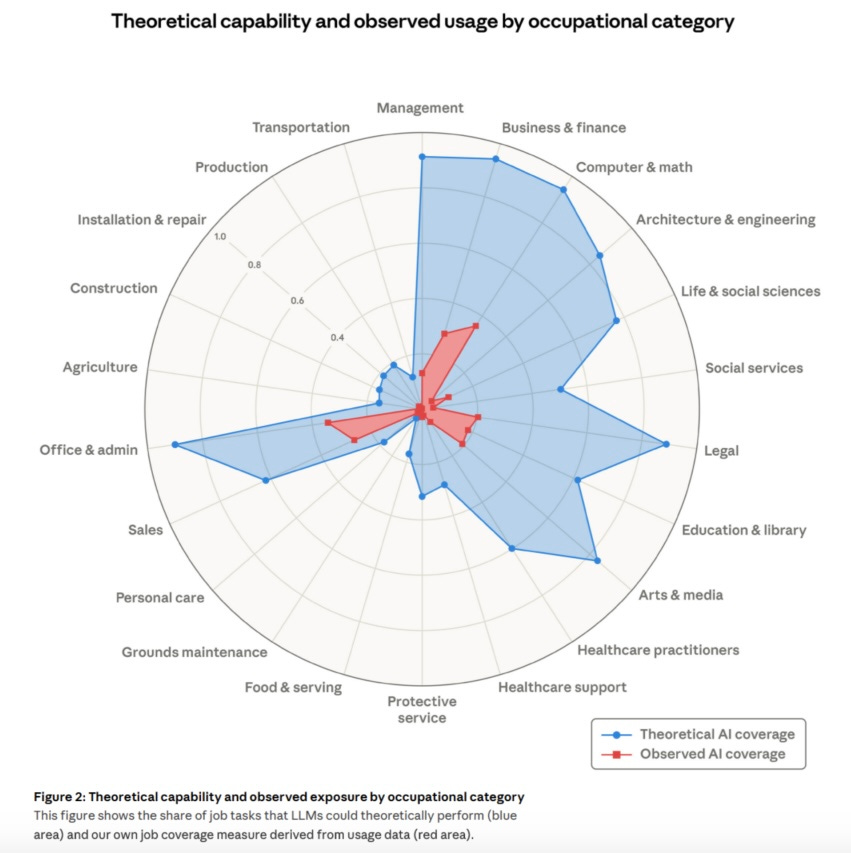
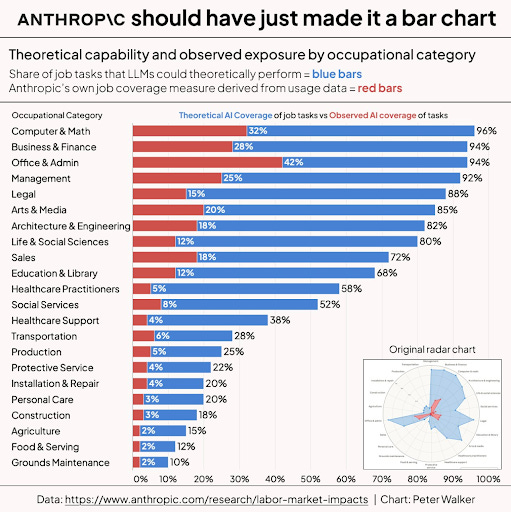
Where does your profession fit into this chart from Anthropic below? Are you one of the people Karp says will have to accept “less good, and less interesting jobs”? Will the theoretical capabilities of AI enable it to take over your job soon?
Anthropic CEO Dario Amodei last year said the technology could disrupt half of entry-level white-collar work. Microsoft’s AI chief, Mustafa Suleyman, made a similar prediction, estimating most professional work will be replaced within a year to 18 months. (source)
With few exceptions, people are rushing headlong into AI and using it for so many things where it doesn’t really add value and may even be destructive (e.g., AI therapists, AI companions, AI warfare strategists).
I do use some AI tools judiciously (e.g., Granola AI). But I don’t let AI saturate ALL of my tasks and life. I kind of like using my cognitive skills and judgment as much as possible.
As usual, humanity is frantically adopting a new technology, damn the consequences.
We did it with plastics.
We did it with herbicides and pesticides.
We did it with the automobile.
We did it with social media.
We keep doing it with pharmaceuticals.
I just wish that—for once—we would be smarter about the research, the rollout, and establishing intelligent ethical guardrails.
Some people predict that AI will eliminate millions of jobs. Some have denied that AI will take jobs. In fact, they claim the rise of AI will create a host of new jobs. A few admit that jobs are indeed disappearing (you need fewer employees when they can leverage AI to accelerate work and take on tasks that others used to provide).
As usual, the actual answer is complex, and no one can predict the future. The best we can do is try to ride the wave and see where it takes us.
I’ve seen a lot of tech trends
I’ve been in the working world for a very long time—before personal computing, the internet, and cellphones entered the scene. So, I’ve experienced and observed the disruption caused by new technologies. Some were a flash in the pan, while others stuck and changed our lives forever (for better or worse).
I know some people who behaved like squirrels on their ninth cup of coffee. They would leap into every new tech trend and embrace it with a rabid passion, only to abandon it a few weeks or months later when a new shiny object appeared.
That’s not exactly an optimal use of your time and energy!
However, at the other end of the spectrum, I watched other people complain grumpily about every new tech trend and refuse to engage with any of it. Before long, those people’s dusty skills were irrelevant, and they struggled to remain employed.
That sucks, too.
So, what is one to do with this AI trend? Will you be a squirrel with ADHD, a stubborn tortoise, or something in between? It boils down to the following career choices.
Five options
Ignore
Adapt
Ascend
Pivot
Escape
Scroll up to listen to the audio of this episode to hear my full thoughts on all of this.
Schedule a complimentary call with me if you want to discuss how AI is impacting your career and profession, and what you should do about it.
Additional Reading
It’s tempting to offload your thinking to AI. Cognitive science shows why that’s a bad idea
Harvard professor says AI users are losing cognitive abilities
I’m Larry Cornett, an executive coach who works with ambitious professionals to help them reclaim their power, become more invincible, and create better opportunities for their work and lives. Do more of what you love and less of what you hate! 📕 Check out The Invincible Daily Journals!

Would you like to help support my newsletter and podcast, but don’t want to commit to a monthly fee? Check out my ☕️ Buy Me a Coffee. I’m a solopreneur, and coaching and writing are how I provide for my family. Thanks for your help!


